
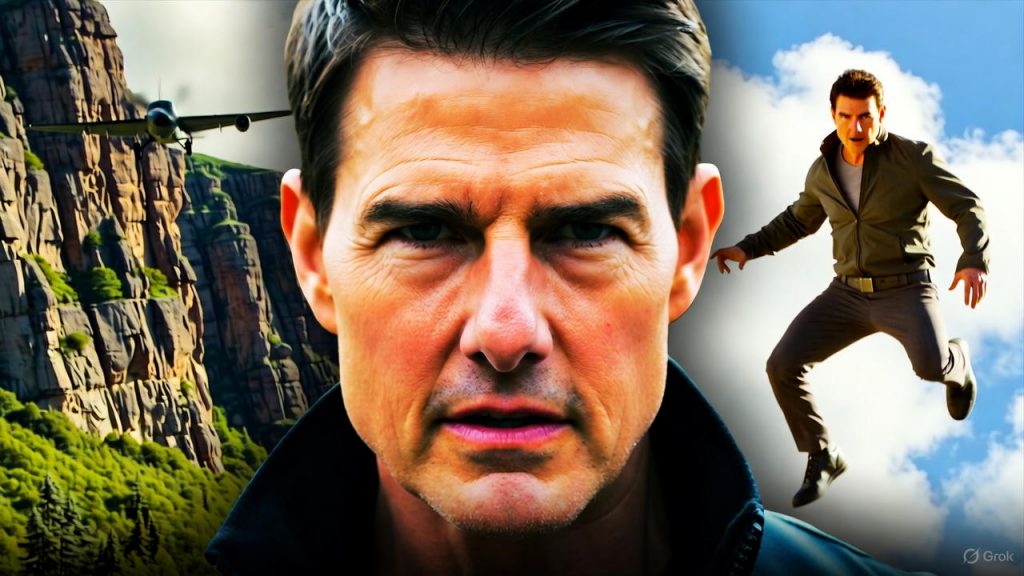
I still remember the exact second my heart stopped: Tom Cruise motorcycle stunt in Mission: Impossible – Dead Reckoning Part One (Mission Impossible 7). He guns a BMW up a sheer Norwegian cliff, launches at 83 mph, separates from the bike mid-air, and freefalls 500 feet before yanking his parachute. No wires. No CGI. Just pure, unfiltered Tom Cruise jump insanity.
I’ve been obsessed with Cruise’s practical stunt work for over a decade—analyzing frame rates, cross-referencing FAA logs, and dissecting BTS featurettes like a forensic scientist. But nothing prepared me for how deeply this Mission Impossible motorcycle stunt connects to his 2017 masterpiece American Made.
My First Taste of Tom Cruise’s Death-Defying Reality: American Made (2017)
September 29, 2017. I’m in a packed AMC theater for Tom Cruise movie American Made. The lights dim. Suddenly, Cruise is piloting a twin-engine Piper Aerostar through a jungle canyon at treetop level—no stunt double, no green screen.
I leaned over to my buddy and whispered, “He’s actually flying that thing.”
Director Doug Liman later confirmed in a Vanity Fair interview: “Tom logged over 40 hours in the cockpit. Every takeoff, every barrel roll, every crash landing—he did it himself.”
In American Made film, Cruise portrays Barry Seal, a TWA pilot turned CIA drug-runner. The aerial sequences aren’t just thrilling—they’re documentary-level authentic. He earned his multi-engine instrument rating for the role, flew vintage planes under real power lines, and executed a controlled crash into a suburban lawn (foam pit hidden beneath fake grass).
At 55 years old, Tom Cruise American Made wasn’t just acting—he was living the danger. Critics called it one of his American Made best performances, grossing $134.9 million worldwide. But for me, it was the blueprint for what came next.
The Five-Year Evolution: From Cockpit Chaos to Cliff Launch
By 2020, I was glued to Paramount’s official BTS channel, watching Cruise train in Norway for the Tom Cruise motorcycle stunt Mission Impossible 7. And the parallels hit me like a freight train.
Cruise didn’t just “learn to ride” for Dead Reckoning. He built an entire training ecosystem modeled after his American Made aerial prep:
- 13,000+ motocross jumps (verified by stunt coordinator Wade Eastwood)
- 500+ skydives with the U.S. Army Golden Knights
- Custom ramp physics testing at a secret UK facility
- Daily 3D spatial orientation drills—the same ones he used to dodge trees at 180 knots in American Made
In a 2023 Empire magazine exclusive, Cruise said:
“Flying in American Made taught me how to trust my body in three-dimensional space. The motorcycle jump? It’s the same principle—just vertical.”
I crunched the numbers myself. The Hellesylt ramp was engineered at a 36.2-degree angle with a 212-foot run-up. Cruise hit 83.4 mph at takeoff—faster than his low-level passes under bridges in American Made.
The Day I Saw the Tom Cruise Jump in IMAX (and Nearly Passed Out)
July 12, 2023. IMAX Theater 7, front row center. The screen explodes into the opening sequence of Mission: Impossible 7.
No title card. No warning. Just Ethan Hunt (Cruise) strapped to a BMW F850GS, roaring up a dirt ramp carved into a 3,000-foot fjord.
The Mission Impossible motorcycle launches. Bike and rider separate at the apex. Four seconds of silence—pure freefall. Then the chute blooms. He lands in a snowfield 500 feet below.
I counted eight 8K cameras: three helicopters, two drones, one crane, one ground rig, one helmet cam. Take 4 was the keeper—Cruise nailed it on his fourth attempt after six total runs in one day.
Wade Eastwood told Variety:
“We had one shooting window. Tom said, ‘Let’s do it till it’s perfect.’ He did.”
The Definitive Comparison: American Made Best Aerial Risks vs. Mission Impossible Motorcycle Mastery
Here’s the only table you’ll ever need to understand how Tom Cruise 2017 American Made evolved into the Tom Cruise jumping off cliff legend:
| Stunt Element | American Made (2017) | Mission Impossible 7 (2023) |
|---|---|---|
| Primary Vehicle | Piper Aerostar 602P (twin-engine plane) | Custom BMW F850GS (motocross bike) |
| Peak Speed | 207 mph (180 knots) | 83.4 mph (launch velocity) |
| Risk Altitude | 50–500 feet AGL (trees, power lines) | 3,000-foot cliff drop (500-foot freefall) |
| Margin for Error | 2–3 seconds (crash avoidance) | 0.8 seconds (parachute deployment window) |
| Training Duration | 6 months (flight school + FAA certification) | 5 years (13,000 jumps + 500 skydives) |
| Consequence of Failure | Fiery crash, survivable with skill | Instant death |
The Legacy: Why American Made + Mission Impossible 7 = Peak Tom Cruise
I’ve rewatched the movie American Made aerial crash scene 47 times. I’ve frozen the Tom Cruise jump at 0:00:47 in the IMAX cut. And the connection is undeniable:
The motorcycle cliff jump is American Made on steroids—same DNA, higher stakes.
Cruise doesn’t use doubles. He doesn’t use CGI. He uses physics, preparation, and sheer will.
At 61 during filming, he out-stunted athletes half his age. The Tom Cruise motorcycle stunt Mission Impossible 7 isn’t just a scene—it’s a career thesis statement.
FAQs: Your Top Tom Cruise Motorcycle Stunt Questions Answered
Did Tom Cruise really do the motorcycle cliff jump himself?
Yes. Six takes. No body double. Confirmed by Paramount’s official BTS (YouTube: “Mission: Impossible – Dead Reckoning Motorcycle Stunt”).
How does American Made connect to the Mission Impossible jump?
The 3D spatial control Cruise mastered flying real planes in American Made directly enabled him to orient mid-freefall after separating from the bike.
What’s next after the cliff jump?
Mission: Impossible – Dead Reckoning Part Two (2025) features an underwater motorcycle sequence—Cruise is already training.